Empire of AI by Karen Hao
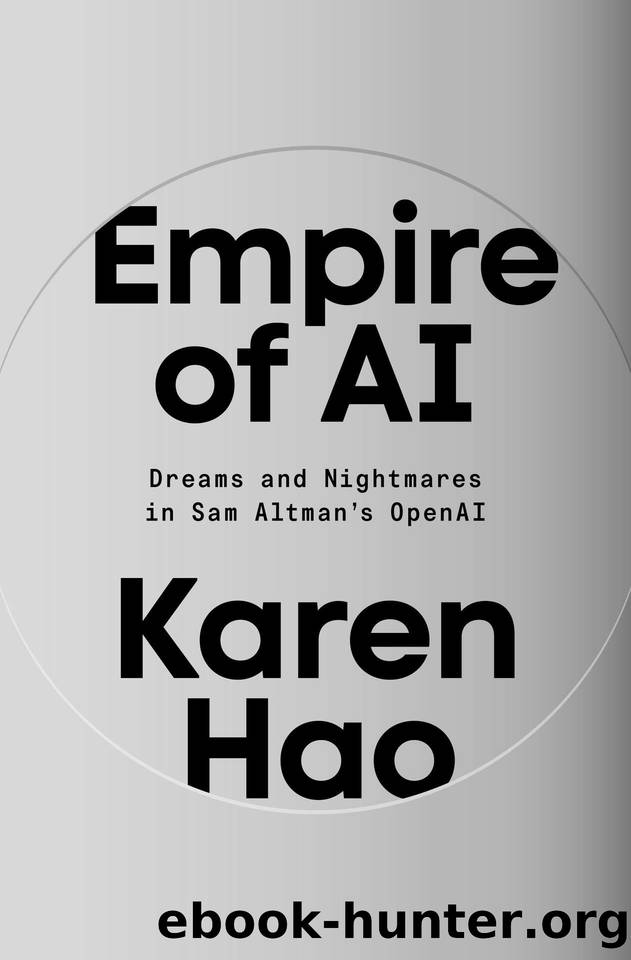
Author:Karen Hao [Hao, Karen]
Language: eng
Format: epub
Publisher: Penguin Publishing Group
Published: 2025-05-20T00:00:00+00:00
Chapter 12
Plundered Earth
In Santiago, Chile, on days after a good rain, the smog washes away and reveals a stunning view of the Andes mountains. The Andes run all the way up and down this thin sliver of a country, from Patagonia at its southern tip over 2,600 miles northâtwice the length of Miami to Bostonâto Chileâs upper border. In this part of the country, the urban landscapes of the capital turn into an endless expanse of desert, which, save parts of Antarctica, is the driest place on earth. The mountains come into sharper focus, their colors more vibrant under the naked sun.
Before Chile was Chile, the Atacama Desert, as it is named, was home to many Indigenous groups. Where others may have seen a punishing barren landscape, they coaxed the desert into a home, tapping the water and minerals deep under the earth to grow crops, raise livestock, and perform ancestral rituals. Then the Spanish arrived. They cut up the region into administrative units with borders. To this day Indigenous elders still warn in oral histories of a repression that grew so violent the Spanish cut off the tongues of anyone who dared to continue speaking their native language. From there, the empire established the countryâs relationship with the rest of the world: It would provide raw resourcesâland, water, energy, mineralsâto strengthen the political and economic agendas of other nations.
Today nearly 60 percent of Chileâs exports are minerals, primarily found in the Atacama Desert, chiefly copper, a highly conductive metal used in all kinds of electronics, and more recently lithium, the essential ingredient for lithium-ion batteries. Those and other resource exports drive the countryâs economy. In Santiago everyone knows someone who lives by the rhythms of the mining industry: During their work âshiftsâ they live in the north; during their days off, they come back to the capital.
The country has struggled to build any other industry to serve as its economic engine. Long after the Spanish empire ended, the US infamously played a key role in ensuring this trajectory. In the 1950s and â60s, as developmental economics took root in Chile and Uruguay, favoring strong government regulation and an inward focus on industrialization as the path to maturing a developing economy, American multinationals who had made billions from their holdings in Chilean mines began to chafe against the growing state taxes and restrictions. The US government subsequently embarked on a quest to refashion Chileâs economic policies to be more favorable to American business interests, launching a program in 1956 called âthe Chile Projectâ to educate a hundred Chilean students at the University of Chicago under the intellectual tutelage of American economist Milton Friedman.
Friedman was a towering figure in economics who would go on to receive a Nobel Prize in 1976 and whose ideas could best be summed up by the title of his influential 1970 op-ed in The New York Times: âThe Social Responsibility of Business Is to Increase Its Profits.â Friedman stood for everything that developmental economics did not:
Download
This site does not store any files on its server. We only index and link to content provided by other sites. Please contact the content providers to delete copyright contents if any and email us, we'll remove relevant links or contents immediately.
Personalized inhaled bacteriophage therapy for treatment of multidrug-resistant Pseudomonas aeruginosa in cystic fibrosis by unknow(208845)
CONSORT 2025 statement: updated guideline for reporting randomized trials by unknow(102477)
Critical evaluation of the ProfiLER-02 study design and outcomes by Vivek Subbiah & Razelle Kurzrock(102013)
Cardiac gene therapy makes a comeback by Oliver J. Müller & Susanne Hille & Anca Kliesow Remes(101805)
Whisky: Malt Whiskies of Scotland (Collins Little Books) by dominic roskrow(74596)
Unveiling the design rules for tunable emission in graphene quantum dots: A high-throughput TDDFT and machine learning perspective by Şener Özönder & Mustafa Coşkun Özdemir & Caner Ünlü(50986)
A yeast-based oral therapeutic delivers immune checkpoint inhibitors to reduce intestinal tumor burden by unknow(40363)
Covalent hitchhikers guide proteins to the nucleus by Alexander F. Russell & Madeline F. Currie & Champak Chatterjee(40284)
Meet the Authors: Christopher R. Mansfield and Emily R. Derbyshire by Christopher R. Mansfield & Emily R. Derbyshire(40187)
Alkaline-earth metals promote propane dehydrogenation with carbon dioxide through geometric effects: Altering the reaction pathway by unknow(32806)
Induced iron vacancies boosting FeOOH loaded on sustainable Fenton-like collagen fiber membrane for efficient removal of emerging contaminants by unknow(32602)
Efficient electric-field-assisted photochemical conversion of methane to n-propanol exclusively over penetrated TiO2Ti hollow fibers by Guanghui Feng(32520)
Bi2SiO5 nanosheets as piezo-photocatalyst for efficient degradation of 2,4-Dichlorophenol by Hangyu Shi & Yifu Li & Lishan Zhang & Guoguan Liu & Qian Zhang & Xuan Ru & Shan Zhong(32459)
A novel NDIPTA organic heterojunction photocatalyst with built-in electric field for efficient hydrogen production by Jiahui Yang & Baojun Ma & Yongfa Zhu(32432)
Enhanced conversion of methane to liquid-phase oxygenates via hollow ferrite nanotube@horseradish peroxidase based photoenzymatic catalysis by Jun Duan & Shiying Fan & Xinyong Li & Shaomin Liu(32397)
Ordered macroporous superstructure of defective carbon adorned with tiny cobalt sulfide for selective electrocatalytic hydrogenation of cinnamaldehyde by Xiao-Shi Yuan & Sheng-Hua Zhou & San-Mei Wang & Wenbo Wei & Xiaofang Li & Xin-Tao Wu & Qi-Long Zhu(32321)
What's Done in Darkness by Kayla Perrin(27236)
Topological analysis of non-conjugated ethylene oxide cored dendrimers decorated with tetraphenylethylene: Insights from degree-based descriptors using the polynomial approach by A Theertha Nair & D Antony Xavier & Annmaria Baby & S Akhila(26617)
Investigation of mechanical and self-healing properties of hydroxyl-terminated polybutadiene functionalized with 2-ureido-4-pyrimidinone by Mohsen Kazazi & Mehran Hayaty & Ali Mousaviazar(26546)
